https://aeon.co/essays/who-are-the-leaders-in-our-heads-and-how-did-they-get-there
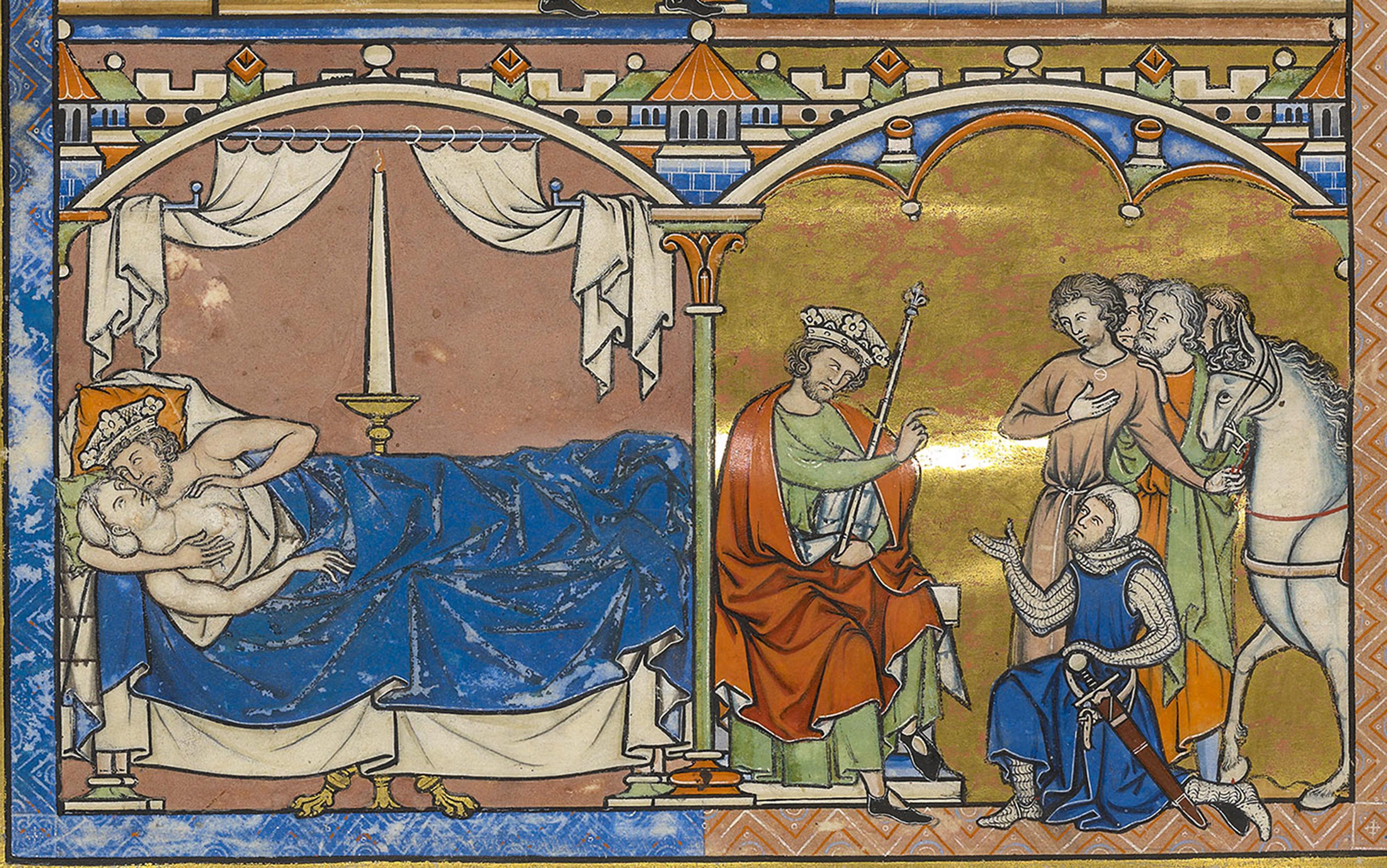
King David sleeps with Bathsheba, the wife of Uriah the Hittite. Joab is summoned to fetch Uriah from the Israelite camp in the hope of covering up the infidelity. From the Crusader Bible. Courtesy the Morgan Library
Moshik Temkin is Distinguished Visiting Professor of Leadership and History at Schwarzman College at Tsinghua University in Beijing, and a faculty affiliate at Harvard University’s Belfer Center for Science and International Affairs. He is also a visiting professor at the Kautilya School of Public Policy, in Hyderabad, India. His most recent book is Warriors, Rebels, and Saints: The Art of Leadership from Machiavelli to Malcolm X (2023). His previous books include The Sacco-Vanzetti Affair: America on Trial (2011). Edited bySam Haselby3,600 wordsSyndicate this essayEmailSavePost
If you search for books on leaders in history, you find a recurring cast of characters staring at you from the covers: Winston Churchill. Napoleon. Abraham Lincoln. Genghis Khan. Mao Zedong. They will often be military or imperial leaders, on horses or in uniform or armour, who triumphed in big wars or led their nation through crisis. Keep browsing and you will encounter another variant of works on leadership, featuring prominent figures from the business world. With varying degrees of sophistication, these men (and, sometimes, women) are treated as heroes, role models and inspirations – or, alternatively, as menaces. Business leaders such as Bill Gates or Jeff Bezos are portrayed, whether positively or negatively, as uniquely powerful individuals – able, through sheer force of will or ruthless intelligence, to overcome any obstacles life put in their way.
Such books are celebrations of individualism. Their primary effect is to promote an individualist perspective on the world. They are popular because their political appeal is so wide: liberals can love this perspective on leadership, and so will conservatives and libertarians. Almost everyone, it seems, enjoys a good success story. But you will usually read little in them about all the things that provided the basis for the success stories but which had nothing to do with the protagonists personally, like being born to wealthy parents in a socially and economically stable country with myriad educational and commercial opportunities. The message from this literary cottage industry is that where there’s a will, there’s a way. ‘Leaders’ are ‘winners’. They built themselves up and achieved greatness through their extraordinary qualities. They made their own history.
It is hard to escape this view of leaders and leadership. It is all around us. We still tend to teach, study and celebrate ‘Great Men’. All over the world, people are in search of larger-than-life figures who can lead them past crises and catastrophes, and into a bright future. Perhaps that is why leaders from a supposedly glorious past loom so large in the gloomy present. But how did we get to this dominant view on leadership, with its focus on all-powerful individualism? To answer this question, we must go all the way back to antiquity, where mythology holds the key. We need to revisit the earliest written works in human history and see what kinds of ideas about leadership they implanted in us. And then, we have to see how these early ideas were countered by a new and compelling vision of leadership that remains with us today.
For hundreds of millions of people, the Bible is not just a book, or even just a sacred book, but the source of how to think about the world. It teaches us about kings, gods, wars, human nature and our origins. Its influence can be direct or indirect, depending on whether one is a religious or secular person. But its profound impact on world civilisations – and on us as individuals – is undeniable. This means that, even if you have never read any of it, you have imbibed many of its teachings and values. So how has it shaped us? What lessons on leadership are we meant to draw from it?
The Book of II Samuel, chapters 11 to 18, presents perhaps the most dramatic and bloody story in the Hebrew scriptures. It begins with King David, sitting in his palace in Jerusalem, lazily gazing at a woman bathing in a nearby house. David has his servants bring her to him. The woman, Bathsheba, is married to a Hittite named Uriah, a soldier in the Israelite army, who is off fighting the Ammonites in one of the wars that had helped establish David as a powerful and wealthy king. From her tryst with David, Bathsheba conceives. Eager to hide his deed, David summons Uriah from the battlefield. After feting him in his palace, David sends Uriah to have a conjugal visit with his wife so that he will be assumed to be the father of David’s child. But Uriah ruins David’s plan when he refuses to go to his house, and instead sleeps outside the king’s door. He explains to David that he could not possibly sleep with his wife and feel the pleasures of home while his fellow soldiers are mired in battle. Uriah’s honour and integrity push King David to greater duplicity: he sends Uriah back to the battlefield with a private message to David’s general, Joab, instructing the general to place Uriah in the battle frontline, where he is likely to be killed. And so it happens: Uriah dies – because of a note that he was ordered to take to his commander without knowing its contents. Back in Jerusalem, Bathsheba grieves for her husband, and David soon makes her the newest of his many wives.
One of the things that makes this episode shocking and disturbing is that David is a sacred figure to Jews, Christians and Muslims. His reputation, as such, is of a great and admirable leader, who rose from nothing; a favourite of God, the modest shepherd boy who was ordained by Him to be king; who felled the mighty Philistine warrior Goliath with only a sling and rock; who played the harp for the tormented first king of the Israelites, Saul; who saw the face of God, and spoke to Him, and according to Jewish tradition, his house would be the king of Israel’s in perpetuity, and the Messiah (for Christians, this was Jesus Christ) would come from his lineage. In II Samuel, before his encounter with Bathsheba, David rises to great power and expands his kingdom by triumphing in wars, protected and beloved by God, and always with righteousness.
But in his behaviour towards Bathsheba and Uriah, David is human, not godly – even low and immoral and slothful. He is the exact opposite of what we might expect a great leader to be. He no longer leads men on the battlefield or sets a personal example of modesty and courage, as he once did, but sits in a luxurious palace, a fat cat, a Peeping Tom, while others fight and die on his behalf. So the scriptures give us a darker portrait of David than those who only know him by reputation – as an icon, filtered through mythology or belief – might presume.
David said to Nathan: ‘The man who did this deserves to die!’ Nathan’s response to David is: ‘You are that man’
Soon after Uriah’s death on the battlefield, the direct result of David’s orders to Joab, the Prophet Nathan pays King David a visit. Prophets play a crucial role: they carry the word of God and serve as spiritual authorities. Nathan is thus one of the only people who can speak directly and freely to David, without fear, since it is like God speaking. Nathan tells the king a story about a rich man and a poor man. The rich man had a large number of sheep and cattle, but the poor man had only one little lamb. ‘He raised it, and it grew up with him and his children. It shared his food, drank from his cup, and even slept in his arms. It was like a daughter to him,’ Nathan tells David. One day, the rich man had a visitor and, instead of taking one of his many sheep to prepare a meal for the visitor, he took the one little lamb that belonged to the poor man, killed it, and served it.
The Bible then tells us that, upon hearing this story, ‘David burned with anger against the man’ and said to Nathan: ‘As surely as the LORD lives, the man who did this deserves to die! He must pay for that lamb four times over, because he did such a thing and had no pity.’ Nathan’s response to David is: ‘You are that man.’ And Nathan continues, channelling God’s voice: ‘I anointed you king over Israel … Why did you despise the word of the LORD by doing what is evil in his eyes? You struck down Uriah the Hittite with the sword and took his wife to be your own … Now, therefore, the sword will never depart from your house … Out of your own household I am going to bring calamity upon you.’
Upon hearing Nathan’s words, David collapses in guilt, saying: ‘I have sinned against the Lord.’ Nathan reassures him that God will spare his own life. But, from this point on, David and his family experience a stunning series of tragedies. First, Bathsheba’s baby, David’s son, becomes gravely ill. David and his servants pray and cry and fast, to no avail: the baby dies. (After this, Bathsheba becomes pregnant again – this time with Solomon, whom we are told God loves, and who would eventually succeed David as king.)
The biblical author then recounts the grim episode involving three of David’s older children, Amnon, Tamar and Absalom. Amnon becomes obsessed with his half-sister Tamar. He lures her to his house by pretending to be ill, and asks Tamar to feed him. She does, and offers to feed Amnon cakes of meat, but he declines, instead asking her to lay with him. When she is horrified at the idea and tries to placate him by telling him to speak about his desire with their father, he attacks and rapes her, despite her begging him to stop; once finished, he is consumed with ‘hatred’ for her and throws her out of his house. The devastated Tamar goes to her brother Absalom, who upon learning what happened never speaks to his half-brother Amnon again; we are told that ‘he hated Amnon because he had disgraced his sister Tamar.’
Two years pass. Absalom seems to have moved on (about Tamar we are told nothing). But then through trickery, Absalom manages to gather all the king’s sons – his brothers and half-brothers – and instructs his servants to murder Amnon. When the news gets to King David, he is first horribly misled to believe that Absalom has killed all his male siblings, all of David’s sons. Absalom flees Jerusalem and goes to Geshur, where he stays for three years. David is described as much more sad than angry; he ‘longed to go to Absalom, for he was consoled concerning Amnon’s death.’
The rest of the episode is both moving and shocking. Absalom and David reconcile after three years of estrangement, a tender moment between father and son that inspired great works by artists from Rembrandt to Marc Chagall. But Absalom is soon overcome once again by his demons. He launches a rebellion against his father, who is forced to flee Jerusalem. Eventually, after a bloody war between Absalom’s army and those who remain loyal to David, Absalom is killed in gruesome fashion. David does not celebrate his victory and restoration to the throne; instead, he is shattered, and the episode ends with David wailing in grief: ‘O my son Absalom! My son, my son, Absalom! If only I had died instead of you – O Absalom, my son, my son!’ What are we meant to learn from this horrific tale?